Medical office cleaning is not just harder office cleaning. It is a different job with different rules, and a contractor who treats a clinic like an office will cost you on your next inspection.
So here is what a facility manager should expect from a cleaning contractor in a clinic, dental practice or outpatient suite. And what to ask before you hire one.
Why medical office cleaning is different
- Cross-contamination risk. The order of work and the equipment used both matter clinically, not just cosmetically.
- Documentation. What was cleaned, when, and by whom may need to be shown to an inspector.
- Product requirements. Disinfectants have contact times and approved use lists. Using the wrong product, or the right product wrongly, is a compliance problem.
Contact time is the thing crews get wrong
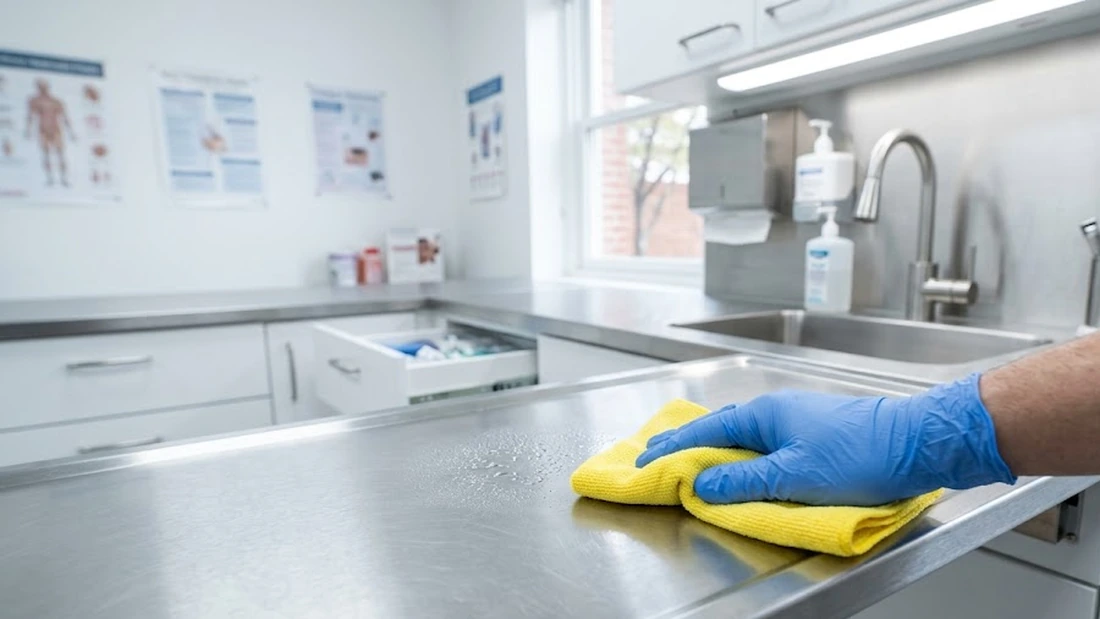
Still, every disinfectant has a dwell time – the number of minutes the surface must stay visibly wet for the product to work as labeled. It is commonly somewhere between one and ten minutes depending on the product.
In practice, the most common failure in medical cleaning is spraying and immediately wiping. The surface looks clean. The disinfection did not happen.
So ask any bidder what the contact time is for the product they use. If they do not know the number, they are not ready for a medical space.
Zones and color coding
- Exam and treatment rooms
- Restrooms
- Waiting and reception
- Staff and break areas
- Utility and soiled rooms
Therefore color-coded microfiber is the standard way to enforce this. Red for restrooms, another color for clinical areas, and so on. One cloth per room, then into the laundry – never back into the bucket.
Watch a crew work. If the same cloth goes from a restroom to an exam room, that is a serious problem, whatever product is on it.
High-touch surfaces come first
- Door handles, push plates and light switches
- Exam table edges and paper roll holders
- Chair arms in waiting areas
- Reception counter and pens
- Keyboards, phones and card readers
- Grab rails and dispenser handles
Crews should disinfect these every visit, with the correct dwell time, before general surface cleaning.
What you should be handed after each visit
- A checklist showing what was completed, dated and signed
- Product names and EPA registration numbers on file
- Safety data sheets available on site
- A log of any incident or damage
Waste handling
Be explicit about the boundary. Generally, regulated medical waste is handled by a licensed medical waste contractor, not the cleaning crew. Your cleaning contract should state clearly what the crew does and does not touch.
Floors in clinical spaces
- Neutral pH cleaner for routine work
- No aggressive pads that scratch the wear layer
- Attention to coved bases where floor meets wall
- Periodic scrubbing scheduled outside patient hours
Scheduling around a practice
- Agree exactly when the crew can enter and how they get in
- Agree which rooms are off limits and how they are marked
- Keep the same crew – familiarity with a clinical layout matters more here than anywhere
- Plan periodic work around the practice calendar, not the cleaning company calendar
Questions to ask before hiring a medical office cleaning contractor
- What disinfectant do you use and what is its contact time?
- How do you prevent cross-contamination between zones?
- Are your crew trained on bloodborne pathogens, and when was the last refresher?
- What documentation do I receive after each visit?
- Are these your employees?
- Do you currently clean other medical suites, and can I call one?
Medical and dental suites in Greater Cincinnati
For the service itself, see medical facility cleaning in Cincinnati, OH.
We clean medical and dental suites across Greater Cincinnati with color-coded equipment by zone and a written checklist filed after every visit.
This article is general guidance for facility managers. Your own regulatory obligations depend on your practice type and licensing body – check requirements with your compliance advisor.
The standards behind this
Cleaning staff in a clinical setting fall under OSHA’s bloodborne pathogens standard, which sets the training and PPE expectations you should be seeing evidence of. On the chemical side, practices that want lower-toxicity products without losing efficacy usually start from the EPA Safer Choice list.