
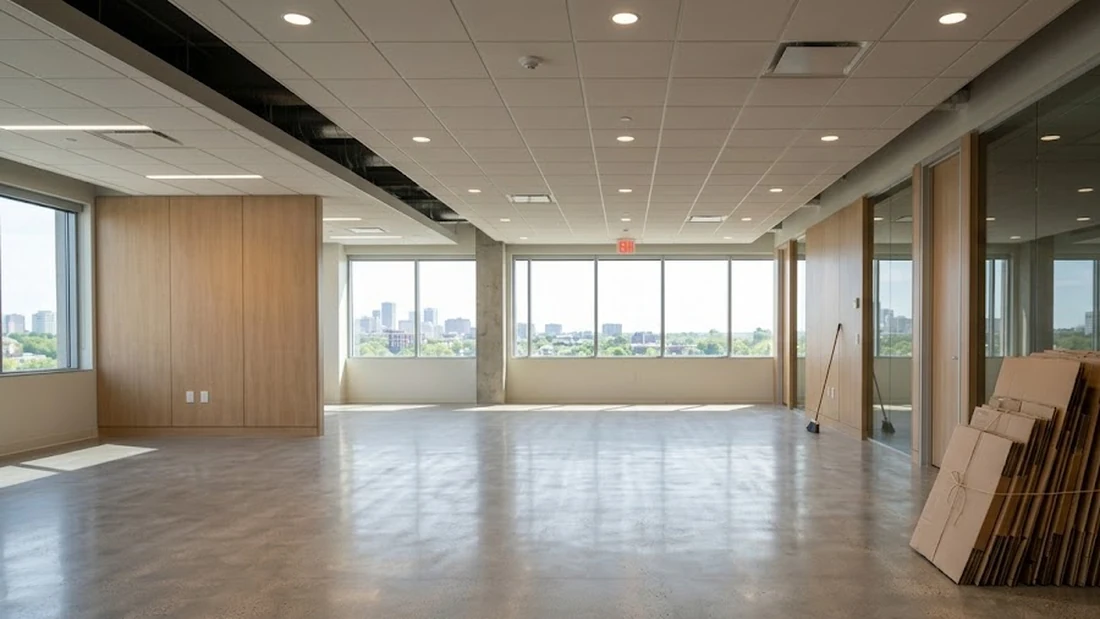
A vacant commercial suite earns nothing. Every week between one tenant leaving and the next one signing is rent you do not collect. So the turnover clean sits directly on your bottom line.
Here is how commercial move-out cleaning works, what it should cost, and how to stop the clean from being the thing that delays your listing.
What commercial move-out cleaning actually covers
It is not the same as janitorial. A nightly crew maintains an occupied space. Instead, a turnover clean deals with everything a tenant left behind and everything their furniture was hiding.
- Trash-out – furniture, equipment, files and rubbish left behind
- Removal of signage, fixings, cable trays and wall anchors where agreed
- Full dust removal top down, including vents and light fixtures
- Walls washed, marks and adhesive removed, holes flagged for patching
- Cabinets and casework cleaned inside and out
- Restrooms deep cleaned and sanitized
- Kitchens and break rooms, including appliance interiors
- Interior glass and partitions
- Floors deep cleaned by finish type, carpet extracted or hard floor scrubbed
The three states a suite can be in
Clean exit. Tenant removed everything and left the space broom clean. In that case you need a deep clean, not a trash-out. Fastest and cheapest.
Partial exit. Furniture and equipment left behind, some rubbish, walls full of anchors. Most common. Needs a trash-out before cleaning can even start.
Abandoned. Everything left, sometimes including waste and spoiled goods. Needs hauling, possibly disposal permits, and often a specialist clean before a standard turnover clean.
So when you get quotes, tell the cleaning company which of the three you have. A quote given over the phone for a clean exit that turns out to be an abandoned suite will not hold.
Sequence matters
- Trash-out first. Nothing else can happen while the space is full.
- Repairs and patching. Wall repairs, damaged tile, ceiling tiles.
- Painting. Always before the final clean, never after.
- Floor work. Carpet replacement or hard floor restoration.
- Final clean. Last, once everyone else is out.
The most common mistake is booking the clean before painting. Then the painters leave dust, spatter and tape residue on a space you already paid to have cleaned.
What it costs
We price move-out cleaning per square foot, with a separate line for trash-out. That is because hauling is a different job with different costs.
Expect the cleaning portion to sit in a similar band to post-construction final cleaning. Trash-out works differently. It goes by volume: how many truckloads, how far to the disposal site, and whether anything needs special handling.
Two things drive the price up fast: heavy furniture on upper floors with no service lift, and anything that cannot go in a standard dumpster.
Getting it back on the market faster
Book the walkthrough before the tenant leaves. Walk the space a week before the exit date if you can. The crew then arrives knowing exactly what it faces, and we can schedule it properly.
First, deal with the trash-out and the clean as one job. Two vendors means two schedules, two site visits, and a gap in the middle.
Get photos. A photo record of the condition at handover protects your deposit claim and settles arguments later.
Second, do not skip the detail work in an empty suite. Prospective tenants walk empty rooms slowly. After all, there is nothing to look at except the surfaces. Instead, dusty vents and marked walls are what they see.
Deposit disputes
- Photograph the space before any work starts, with a timestamp
- Get an itemized invoice, not a lump sum
- Keep the written scope showing what was done and why
- Photograph the finished space
A lump sum invoice that just says cleaning is easy to dispute. An itemized one with photographs, room by room, is not.
Turning a suite around in Greater Cincinnati
We handle tenant turnovers across Greater Cincinnati. Trash-out and deep clean run as one job, and we file photo-verified checklists afterwards so you have the record for your deposit claim.
Send the square footage, the floor, and roughly what has been left behind, and we will walk it and put a fixed price in writing.
Disposal is not an afterthought
A move-out generates real volume, and where it goes matters. General fit-out debris is covered by the EPA guidance on construction and demolition materials. Anything left behind that counts as hazardous waste (solvents, some lamps, certain batteries) cannot go in the same dumpster, and the landlord usually carries that liability, not the departing tenant.