
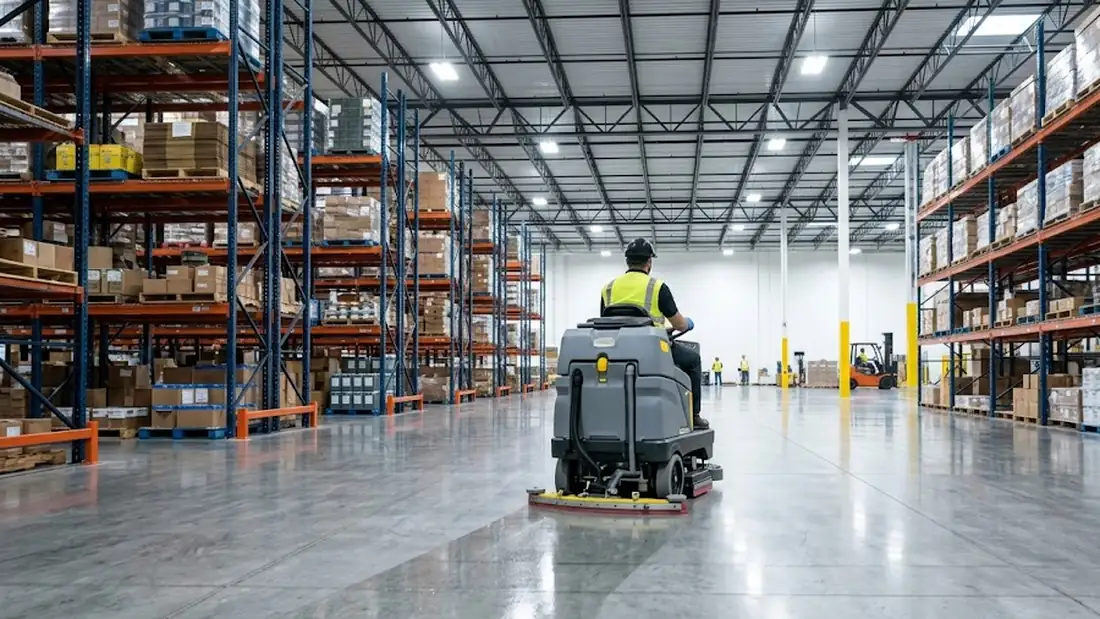
Warehouse floor cleaning gets treated as an afterthought until something goes wrong. For example, a slip claim, a failed audit, or a concrete slab worn badly enough to need grinding.
In practice, industrial floor care is mostly about doing simple things on a schedule. So here is what that schedule should look like.
Know what your floor actually is
Sealed concrete. A penetrating or film-forming sealer. Sweep and auto-scrub with a neutral cleaner. Harsh alkaline products strip the sealer, and once it is gone the slab starts absorbing oil and staining permanently.
Polished concrete. Mechanically ground and densified, not coated. Instead, dust mop frequently and auto-scrub with a neutral cleaner. Also, never use anything acidic – it etches the surface and dulls the polish in patches you cannot buff out.
Epoxy or urethane coating. Common in food, pharma and wash-down areas. Follow the manufacturer cleaner. Meanwhile, watch for coating failure at joints and around drains, and report it early.
If you do not know which one you have, ask before anyone puts a machine on it. Using the wrong chemical is the most expensive mistake in industrial floor care, and it is usually not reversible.
Dust is the real enemy
- Dust mop daily with a treated mop, or use a ride-on sweeper in larger buildings
- Never dry sweep with a broom in a large space – you move dust into the air, not out of the building
- Keep entrance matting long enough to actually work, at least 12 to 15 feet in the main traffic path
- Clean racking uprights and beams on a quarterly cycle
In fact, entrance matting is the cheapest floor care you can buy. After all, most of the grit that damages a floor walks in on shoes and forklift tires.
A warehouse floor cleaning schedule that works
Daily
- Dust mop or sweep main traffic aisles
- Spot clean spills, especially oil and hydraulic fluid
- Clear dock areas and door thresholds
- Check and clean entrance matting
Weekly
- Auto-scrub main aisles and dock areas
- Clean break rooms and restrooms to a higher standard than the warehouse floor
- Wipe down handrails, doors and touch points
Monthly
- Auto-scrub the full floor including under and around racking where accessible
- Clean floor drains
- Detail dock levellers and door tracks
Quarterly
- High-level dusting: beams, ductwork, light fixtures, sprinkler pipe
- Racking uprights and beam faces
- Inspect the floor for coating failure, cracks and joint damage
Safety pays for the cleaning
- Spills cleaned immediately, not at the end of the shift
- Wet floor signage that goes out and comes back in
- Light fixtures cleaned so you get the lux level you are paying for
- Walkways kept clear of pallets and shrink wrap
Dirty light fixtures are an easy win. Similarly, a layer of dust on a high bay lens can cut usable light noticeably, and nobody thinks to check.
Scrubbing without stopping operations
- Zone it. Scrub in sections on a rotating schedule instead of trying to do the whole floor at once.
- Work the shift gap. Even a 90-minute window between shifts is enough for a machine operator to cover a lot of ground.
- Match the machine to the aisle. A machine that cannot turn in your aisles will leave half the floor untouched.
- Plan around inventory cycles. Scrub the areas that are empty after a big outbound.
What good looks like
Walk your building and look. Specifically: no dust film on beams or racking, no grit underfoot, drains clear, matting clean and lying flat, and no standing liquid anywhere.
So ask your contractor when the racking was last dusted, and when the full floor was last scrubbed. If they cannot tell you, there is no schedule, just someone showing up.
Warehouse and industrial cleaning in Ohio
For the service itself, see warehouse cleaning services in Cincinnati, OH.
We clean warehouse and light industrial buildings across Greater Cincinnati, and handle post-construction cleaning for industrial turnovers in Dayton and Columbus as well.
Then send your square footage, floor type and shift pattern, and we will walk the building and put a schedule and a fixed price in writing.
Why the schedule matters
Floor condition is a safety issue before it is a cosmetic one. Slip, trip and fall duties for walking surfaces are set out in OSHA’s walking-working surfaces standard. Airborne concrete and product dust is the other half of the problem, and the EPA’s indoor air quality guidance explains why sweeping a slab dry makes it worse rather than better.