
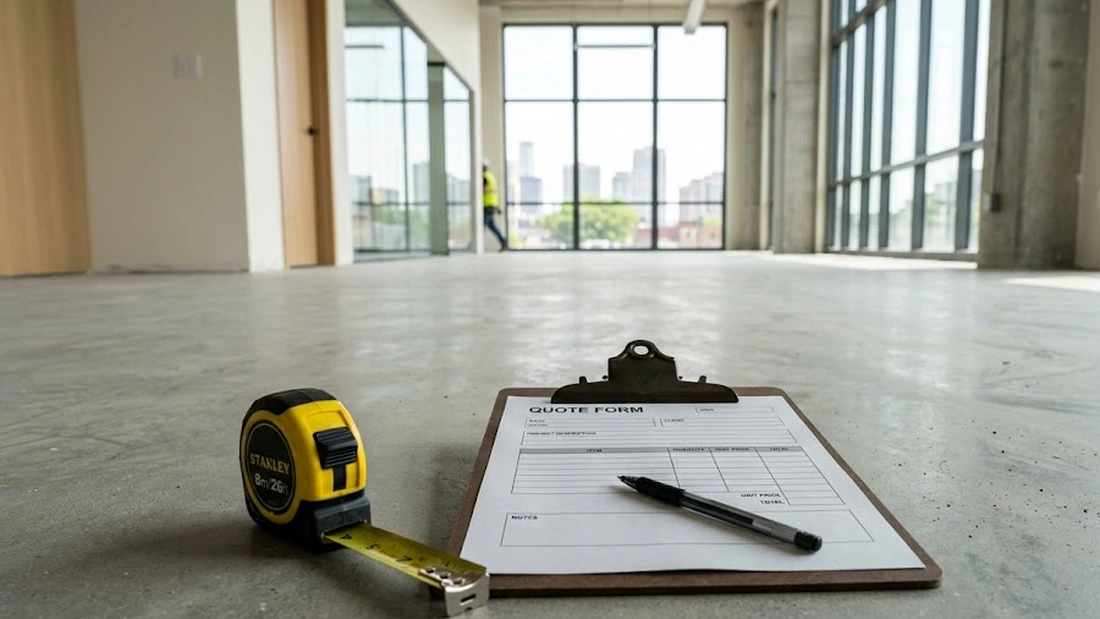
If you are budgeting a commercial turnover in Ohio, what you really need is a clear, itemised scope. Most contractors get handed a lump sum with no explanation, then have no way to tell whether the number is fair or padded.
So this guide explains the ranges, what moves the price up or down, and how to compare two quotes that look nothing alike.
The short answer
Most contractors price post-construction cleaning per square foot. The rate swings widely, though, with the condition of the space, the phases involved and the finish level. In practice, the only accurate number comes from a walkthrough of your actual building, which we do for free.
In practical terms:
- 5,000 sq ft office suite – a straightforward single-phase final clean
- 12,000 sq ft medical fit-out – multi-phase work with detailed sanitising
- 40,000 sq ft warehouse – often lower per foot, because open floor is faster than detail work
Those are national ranges. Greater Cincinnati, Dayton and Columbus generally sit in the middle of them, not at the top.
Why the range is so wide
In fact, two 10,000 sq ft jobs can differ by three times in price. That is because square footage alone tells a cleaning company almost nothing. Here is what actually drives the number.
1. Which phase you are buying
Post-construction cleaning is not one job. It is normally three: rough clean, final clean, and touch-up. A quote for post-construction cleaning that covers all three will look expensive next to a quote that only covers the final clean. Always ask which passes the quote includes.
2. Detail density
An open warehouse floor is fast. A medical suite with cabinets, casework, exam sinks, blinds and glass partitions, however, is slow. Cleaners charge in labor hours, and detail work eats hours.
- Warehouse and industrial – lowest
- Retail and open office – moderate
- Medical, dental, laboratory, restaurant – highest
3. How much dust the trades left
Generally, drywall dust is the single biggest cost driver. A site that was swept as trades finished cleans far faster than one where dust has been ground into the floor for six weeks. If the general contractor kept the site tidy, the cleaning quote should reflect it.
4. Ceiling height and access
So anything above ladder height means lifts, more time, and more crew. Exposed ductwork, high bay lighting and warehouse racking all raise the price.
5. Glass
Interior glass partitions, storefront glass and window walls are priced separately by many companies. If your building is glass heavy, ask whether interior and exterior glass are both included, and to what height.
6. Schedule
A crew that works nights and weekends to hit your handover date costs more than one that works a normal Tuesday. Rush turnovers usually carry a premium. So does having to work around trades still on site.
How to compare two quotes properly
Contractors often send us a competitor quote and ask why ours is different. But nine times out of ten the two quotes are not for the same work.
Ask every bidder these six questions:
- Which phases are included? Rough, final, touch-up, or only one of them.
- Is interior glass included, and to what height?
- Is the touch-up after the punch list included, or extra?
- Who supplies consumables? Liners, paper, filters.
- Is debris removal included, and does that mean hauling off site?
- Is it a fixed price or an hourly estimate?
That last one matters more than people expect. An hourly estimate is not a quote. Instead, it is a starting number that can grow, and you carry the risk.
What a fair quote looks like
- The square footage the price is based on
- A line-by-line scope, not one sentence
- Which phases are covered and when each happens
- A fixed price, with change orders only when the scope changes
If a company will not put the scope in writing, the low number on their quote is not a saving. It is a gap that shows up later as a change order, or as a punch list on handover day.
Cheapest is rarely cheapest
The most expensive outcome on a commercial turnover is not the cleaning invoice. It is missing your handover date because the space failed inspection and you had to bring a second crew in overnight.
We have been called in to redo other companies work more times than we would like. The pattern is nearly always the same. A low bid, a vague scope, and a crew that never understood how a final clean differs from a rough clean.
Getting an accurate number for your project
Ultimately, any cleaning company that quotes a commercial turnover without walking the site is guessing. Square footage, finish schedule, dust load and glass count all need eyes on them.
We walk sites across Cincinnati, Dayton and Columbus at no charge, usually within 48 hours. Then we put a fixed price in writing, with the scope line by line. If the number does not work for your budget, we will tell you which passes you can drop. We will also tell you what that means on handover day.
So send your square footage and turnover date, and we will book the walkthrough.
Where the rules come from
Two things drive most of the cost variation above. Silica dust from cutting concrete, block or tile is regulated, and the control measures are set out in OSHA’s respirable crystalline silica standard. Debris volume is the other one, and the disposal side is covered by the EPA guidance on sustainable management of construction and demolition materials. If a bid ignores either, it is not a like-for-like bid.