
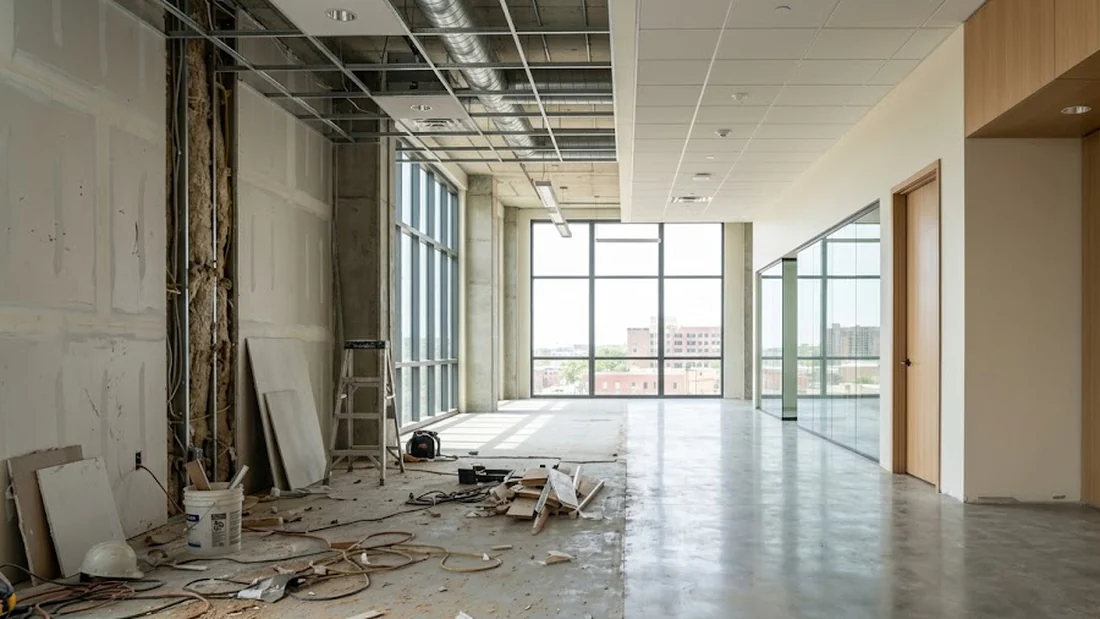
Most problems on a commercial turnover come from one misunderstanding: treating post-construction cleaning as a single job at the end. In practice it is three separate cleans, at three different moments, and each one has a different purpose.
If you budget for one and need three, something gets shortchanged. Usually it is the finish, and it shows up on inspection day.
Phase 1 – Rough clean
When: during construction, between trades.
Purpose: keep the site safe and workable. Of course, this clean is not about how the space looks. It is about whether the next trade can do their job.
What it covers:
- Removing large debris, offcuts, packaging and pallets
- Sweeping and shovelling accumulated drywall dust off floors
- Clearing walkways, stairs and exits so the site stays code compliant
- Pulling protective film and adhesive labels as sections finish
- Removing standing water and site rubbish
Why it saves money: dust walked into a floor for six weeks costs far more to remove later. Dust swept up the same week is cheap. A rough clean is the cheapest hour you will spend on the whole turnover.
Phase 2 – Final clean
When: after the last trade leaves, before occupancy.
Purpose: bring the space to handover condition.
Usually this is the pass people mean when they say post-construction cleaning. It needs a different crew skill set than the rough clean – detail people, not debris crews.
- Full dust removal, top down: ceilings, ducts, light fixtures, sprinkler heads, vents
- Walls wiped, marks and adhesive removed
- Interior glass and window frames, tracks and sills
- Cabinets, casework and drawers cleaned inside and out
- Fixtures, switch plates, door frames and hardware
- Restrooms fully cleaned and sanitized
- Floors vacuumed, mopped, scrubbed or buffed depending on the finish
The order matters. Anyone who mops before dusting the ceiling grid is going to mop twice. Top down, always.
Phase 3 – Touch-up clean
When: after the punch list is closed, right before the walkthrough.
Purpose: deal with everything that got disturbed after the final clean.
Punch list work always leaves marks. Someone touches up paint, adjusts a door, replaces a damaged tile. Then suddenly there are boot prints and dust on a floor that was spotless three days ago.
- Re-cleaning any area touched by punch list trades
- Fingerprints on glass and hardware
- Floors re-mopped or re-buffed
- A final walk with the checklist before handover
This is the pass most often cut from a budget, and the one clients notice most. In the end, the building owner does not see the final clean. They see the space on inspection day.
Typical timeline on a commercial turnover
| Phase | Timing | Who is on site |
|---|---|---|
| Rough clean | Between trades, often more than once | Trades still working |
| Final clean | After the last trade | Empty site |
| Touch-up | 1 to 2 days before walkthrough | Punch list crews finishing |
What happens when phases get skipped
Skip the rough clean: dust gets ground into the floor. The final clean takes longer and costs more, and some floor finishes never fully recover.
Skip the touch-up: the space looks finished on paper and disappointing in person. Handover gets delayed, or the client hands you a punch list of cleaning items.
Buy only a final clean for a job that needed all three: you get a cheap quote and an unhappy client. This is the most common version of the problem.
How to schedule cleaning around your build
Give your cleaning company your handover date first, not last. A good crew works backwards from it:
- Handover date fixed
- Touch-up scheduled 1 to 2 days before
- Final clean scheduled after the last trade leaves, with a buffer day
- Rough cleans scheduled at natural breaks between trades
The most common scheduling mistake is calling a cleaning company the day the last trade finishes. Because even a good crew needs a day or two to staff a large space properly.
Which phases does your project actually need?
Not every job needs all three. A small tenant fit-out that stayed tidy may only need a final clean and a light touch-up. A six-month ground-up build almost certainly needs all three, with several rough cleans along the way.
We walk sites across Cincinnati, Dayton and Columbus and tell you honestly which passes you need and which you can skip. Sometimes the answer costs us work, and we would rather say it than have you pay for a pass you did not need.
Where the rules come from
The rough clean phase overlaps with active construction, so housekeeping duties still sit with the contractor under OSHA 1926.25 on construction housekeeping. Dust generated by cutting masonry falls under OSHA’s respirable crystalline silica standard, which is why the rough pass uses HEPA extraction rather than sweeping.